
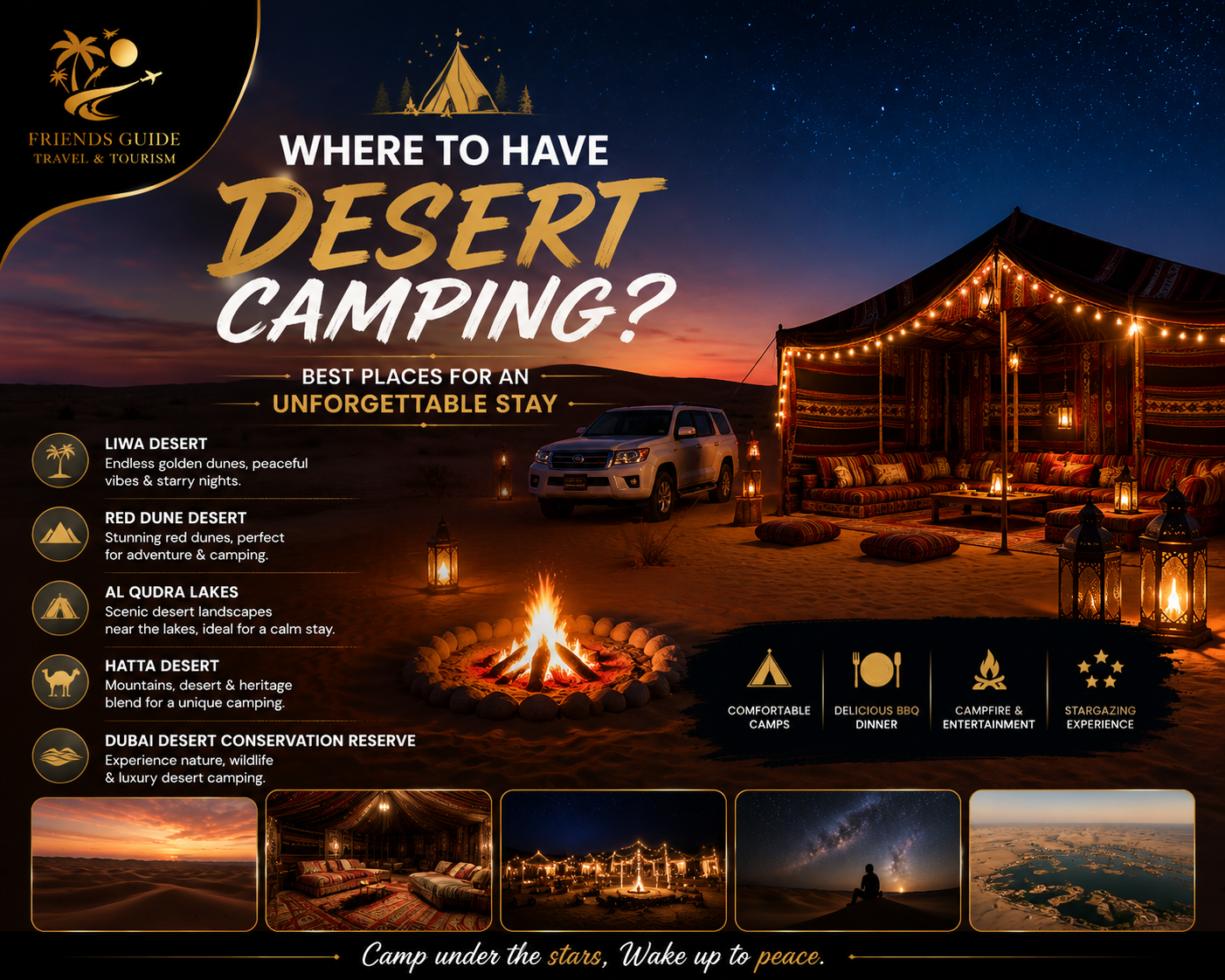
Desert camping is one of the best ways to experience the natural side of the United Arab Emirates. Away from city traffic and illuminated skyscrapers, the desert offers rolling dunes, peaceful sunsets, clear night skies and unforgettable sunrise views.
Travellers can choose a simple self-arranged camping trip, an organised overnight desert safari or a comfortable glamping experience with beds, meals and professional support.
Dubai offers accessible camping areas around Al Qudra, Al Marmoom and the wider desert outside the city. Sharjah is known for Mleiha and Fossil Rock, while Abu Dhabi offers the remote dunes of Liwa, Al Wathba Lake Camp and organised desert accommodation near Jebel Hafit.
However, desert camping requires more preparation than staying inside a hotel. Campers must understand the terrain, monitor the weather, choose a legal and safe location, protect the environment and carry enough food, water and emergency equipment.
Visitors without off-road experience should not drive alone into remote dunes. A professionally organised Overnight Desert Safari Dubai is usually the safest and easiest option for tourists who want to sleep beneath the stars.
Important Desert Camping Notice
Camping rules vary between emirates and locations. Short recreational camping may be allowed in selected open desert areas, while seasonal, long-term, commercial and protected-area camping can require permits or prior approval.
Never camp on private property, protected habitats, military land, active off-road tracks, flood channels or areas displaying no-camping signs. Check the latest municipal guidance and weather alerts before travelling.
Different Types of Desert Camping in the UAE
The term “desert camping” can describe several different experiences. Understanding the options will help you choose a suitable trip.
Independent Tent Camping
Independent camping means bringing your own tent, food, water, lighting and emergency equipment. You are responsible for choosing the location, arranging transportation and removing all waste.
This option is better for UAE residents and experienced campers who understand desert driving, navigation and weather risks.
Organised Overnight Desert Safari
An overnight safari is arranged by a travel company and normally includes transportation, desert activities, camp access, dinner, sleeping equipment and breakfast according to the package.
It is the most practical choice for international tourists, first-time campers and travellers without a suitable off-road vehicle.
Private Desert Camp
A private camp can be arranged for couples, families, groups or corporate events. Depending on the package, it may include private transportation, exclusive seating, personalised food, decorations and a dedicated camp team.
Glamping
Glamping combines the desert environment with hotel-style comfort. Guests may stay in furnished tents, domes, cabins or transparent bubbles with beds, electricity, private washrooms and organised dining.
Seasonal Long-Term Camping
Some residents establish larger family camps during the winter season. These camps remain in place for weeks or months and normally require municipal approval, designated plots and additional safety arrangements.
Best Places for Desert Camping in Dubai and the UAE
The UAE has a wide range of desert landscapes. Some locations are relatively close to the city and suitable for beginners, while others are remote and require advanced off-road preparation.
Choose your campsite according to:
- Your camping experience
- Vehicle type
- Distance from the city
- Mobile-network coverage
- Available facilities
- Weather conditions
- Local camping restrictions
- Whether children or older travellers are joining
1. Al Qudra and Al Marmoom Desert, Dubai
Al Qudra and the wider Al Marmoom area are among Dubai’s most popular outdoor destinations. The region combines golden dunes, artificial lakes, cycling routes, wildlife habitats and wide sunset views.
Al Qudra is suitable for visitors who want a desert experience without travelling deep into a remote part of the UAE. It is commonly visited for picnics, cycling, wildlife observation, photography and stargazing.
Why Choose Al Qudra?
- Relatively accessible from Dubai
- Beautiful desert sunsets
- Stargazing away from central city lights
- Nearby cycling routes
- Wildlife and birdwatching opportunities
- Suitable surroundings for beginner-level outdoor trips
Important Al Qudra Camping Advice
Camp only where overnight stays are currently permitted. Do not pitch tents directly beside protected lake edges, animal habitats, planted areas or locations displaying restriction signs.
- Do not feed birds or desert animals.
- Do not damage trees or plants.
- Keep fire and hot charcoal away from the ground.
- Carry all rubbish and coal away.
- Avoid loud music that disturbs wildlife and other visitors.
- Use existing tracks rather than driving over vegetation.
The wider Al Marmoom area also offers professionally managed heritage and glamping experiences for travellers who prefer organised accommodation.
2. Lahbab Red Dunes, Dubai
Lahbab is recognised for its high red-coloured dunes and wide desert scenery. It is a popular location for dune bashing, quad biking, buggy riding, sandboarding and sunset photography.
The landscape can provide a memorable overnight experience, but independent campers must be careful because the dunes are larger and more difficult to navigate than flat desert areas.
Why Camp Around Lahbab?
- Large red sand dunes
- Beautiful sunset and sunrise views
- Adventure activities nearby
- Excellent landscape photography
- Distance from central Dubai’s light pollution
Who Should Avoid Independent Lahbab Camping?
- Drivers without soft-sand experience
- Visitors using unsuitable two-wheel-drive vehicles
- Solo campers unfamiliar with the region
- Families without emergency and recovery equipment
Tourists can experience the area more safely through a Red Dune Desert Safari Dubai or an organised overnight package.
3. Al Aweer Desert, Dubai
Al Aweer is a desert district on the outskirts of Dubai and has been associated with designated winter camping areas during selected seasons.
It can be practical for residents seeking a location closer to the city. However, the boundaries and permitted seasonal plots can change from year to year.
Before Camping in Al Aweer
- Check Dubai Municipality’s current winter-camping map.
- Confirm whether your planned stay requires a permit.
- Do not enter allocated private plots.
- Avoid construction zones and heavy-vehicle routes.
- Follow Civil Defence requirements for larger camps.
A large camp that remains in place for an extended period is different from a simple one-night recreational tent. Long-term setups normally require formal approval.
4. Mleiha and Fossil Rock, Sharjah
Mleiha is one of the UAE’s most interesting desert destinations because it combines natural landscapes, archaeology, ancient history and outdoor adventure.
Visitors can explore dunes, Fossil Rock, archaeological sites and desert trails before spending the night beneath a clear sky.
Why Choose Mleiha?
- Impressive dune and rock formations
- Archaeological and historical attractions
- Guided desert tours
- Glamping and organised camping options
- Trekking and hiking
- Stargazing programmes
- Dune buggy and off-road activities
Mleiha National Park and its visitor facilities can advise travellers about suitable camping and glamping options. This makes the area a stronger choice for visitors who want professional support.
Fossil Rock
Fossil Rock is known for geological formations containing evidence of ancient marine life. It offers striking sunrise and sunset views, but campers should avoid damaging the rocks or removing fossils.
Travellers staying in Sharjah can combine their plans with a Sharjah Desert Safari through the red dunes.
5. Al Badayer Desert, Sharjah
Al Badayer is commonly known as Big Red because of its prominent red dune. It is popular with off-road drivers, quad-bike riders and adventure groups.
The area can be exciting for experienced desert campers, but it can also become busy with moving off-road vehicles, particularly during winter weekends.
Al Badayer Safety Advice
- Do not camp beside active dune-driving routes.
- Keep tents visible with safe lighting.
- Avoid the base of a steep dune used by vehicles.
- Supervise children at all times.
- Do not walk across active tracks after dark.
- Choose a flat and quiet area away from commercial activities.
First-time visitors should join an organised safari instead of trying to locate an isolated campsite independently.
6. Liwa Oasis and the Empty Quarter, Abu Dhabi
Liwa is one of the UAE’s most impressive desert regions. It is located in Abu Dhabi’s Al Dhafra area along the edge of Rub’ al Khali, also known as the Empty Quarter.
The region is known for enormous orange-red dunes, oasis settlements, date farms and a deep sense of silence that is difficult to experience close to a major city.
Why Camp in Liwa?
- Massive natural dunes
- Remote desert landscapes
- Beautiful stargazing conditions
- Liwa Oasis and date farms
- Moreeb Dune
- Sunset and sunrise photography
- Traditional Bedouin surroundings
Liwa Is Recommended for Experienced Campers
Liwa is remote, and mobile coverage can be limited in certain areas. Fuel stations, food outlets and emergency support may be far from the campsite.
- Travel with more than one suitable 4×4 vehicle.
- Carry extra fuel and water.
- Use offline navigation.
- Share your route with a trusted contact.
- Do not enter deep dunes without off-road experience.
- Avoid driving after dark.
Visitors without remote-camping experience should book a professionally arranged Liwa Desert Safari with an experienced driver.
7. Al Wathba Lake Camp, Abu Dhabi
Al Wathba Lake Camp is a suitable option for visitors who want a more organised outdoor experience than completely independent wild camping.
The area combines desert scenery with lake views and designated camping and picnic spaces.
Why Choose Al Wathba?
- Designated camping plots
- Picnic areas
- Lake and desert scenery
- Family recreation facilities
- Cycling and outdoor activities
- Easier planning than remote dune camping
Visitors should check the latest reservation, access and facility information before travelling because campsite-management arrangements can change.
8. Jebel Hafit Desert Park, Al Ain
Jebel Hafit Desert Park provides a combination of desert scenery, mountain views, archaeology and organised overnight accommodation.
Visitors may choose between furnished camping options and areas where they can bring their own equipment, depending on current availability.
Experience Highlights
- Mountain and desert landscapes
- Archaeological surroundings
- Traditional tents
- Comfortable glamping domes or bubbles
- Family-friendly outdoor activities
- Easy combination with an Al Ain trip
This option is suitable for travellers who want the atmosphere of desert camping without driving deep into an unmarked dune area.
Independent Desert Camping vs Overnight Desert Safari
Both options allow you to sleep in the desert, but the planning, comfort and responsibility are very different.
Choose Independent Camping When You:
- Have desert-driving experience
- Own or have access to suitable camping equipment
- Can navigate safely without a guide
- Understand local camping regulations
- Can manage food, water, fire and waste responsibly
- Are travelling with another prepared vehicle
Choose an Overnight Safari When You Want:
- Hotel pickup and drop-off
- A professional desert driver
- Dune bashing and safari activities
- Dinner and refreshments
- Prepared sleeping equipment
- Breakfast according to the package
- Washroom facilities
- Support throughout the night
An overnight safari is usually better for tourists, solo travellers, couples and families visiting the UAE for the first time.
Do You Need a Permit for Desert Camping in Dubai?
Permit requirements depend on the location, purpose and duration of the camp.
Short Recreational Camping
A short weekend camping trip in an approved open-desert location may not require advance permission under current Dubai guidance. However, campers must still obey location-specific signs, environmental rules and access restrictions.
Long-Term or Seasonal Camps
Camps that remain in place for weeks or months generally require approval from the relevant municipality and must use designated areas.
Commercial Tourist Camps
Travel companies and tourism establishments cannot simply build and operate a commercial desert camp without the required licences, safety approvals and tourism permits.
Protected and Managed Locations
Wildlife reserves, national parks, managed campsites and archaeological areas can have separate booking or permission requirements.
Always Confirm Before Travelling
- Whether overnight camping is currently permitted
- Whether a booking or permit is required
- Whether campfires and BBQs are allowed
- Whether ordinary vehicles can reach the site
- Whether the area closes after a particular time
What Is the Best Season for Desert Camping?
November to March
The cooler winter period is generally the best time for desert camping in Dubai and the UAE. Daytime conditions are more comfortable, while nights can become pleasantly cool.
January and February can feel cold in remote deserts, particularly when wind speeds increase.
October and April
These shoulder-season months can be suitable, but afternoons may remain warm. Set up the tent later in the day and carry enough drinking water.
May to September
Summer camping is not recommended for inexperienced visitors. High temperatures and humidity can create serious health risks, even during the evening.
Travellers seeking a desert experience during warmer months should choose a shorter evening safari with organised transportation and facilities.
How to Choose a Safe Desert Campsite
A beautiful campsite is not necessarily a safe campsite. Examine the surroundings before setting up your tent.
Choose a Location That Is:
- Flat and stable
- Away from steep dune faces
- Visible to approaching vehicles
- Away from active driving tracks
- Outside flood channels and low ground
- Away from vegetation and wildlife habitats
- Legally accessible
- Within a safe distance of your vehicle
Do Not Camp:
- At the bottom of a steep dune
- Inside a wadi or flood channel
- On a road or off-road driving path
- Directly beneath unstable rocks
- On private or restricted land
- Beside protected lake edges
- Under high-voltage power lines
- Near construction or industrial areas
Reach your campsite before sunset so you can examine the terrain in daylight.
Vehicle and Off-Road Preparation
A normal car may reach some firm-sand or managed camping areas, but deep dunes require a properly maintained 4×4 vehicle and an experienced driver.
Recommended Vehicle Equipment
- Full fuel tank
- Working spare tyre
- Tyre-pressure gauge
- Air compressor
- Rated recovery rope
- Recovery points
- Shovel
- Traction boards
- Vehicle jack suitable for sand
- First-aid kit
- Fire extinguisher
- Offline map or GPS
Important Driving Advice
- Do not travel alone into remote dunes.
- Never use an unsuitable tow point.
- Reinflate tyres before returning to the motorway.
- Do not drive when tired.
- Avoid high-speed night driving in the desert.
- Follow existing tracks where appropriate.
Travellers who want an off-road adventure without operating their own vehicle can book a Premium Evening Desert Safari with professional transportation.
Complete Desert Camping Packing List
Sleeping and Shelter
- Weather-appropriate tent
- Groundsheet
- Strong tent pegs for sand
- Sleeping bags
- Sleeping mats or air mattresses
- Pillows and blankets
- Extra rope and repair tape
Lighting and Power
- Headlamps
- Battery lanterns
- Spare batteries
- Power banks
- Vehicle charger
- Emergency warning lights
Safety and Navigation
- First-aid kit
- Fire extinguisher
- Offline maps
- Compass or GPS
- Whistle
- Emergency contact information
- Fully charged mobile phone
Clothing
- Comfortable daytime clothing
- Warm evening layer
- Closed shoes
- Sun hat
- Sunglasses
- Extra socks
- Wind-resistant jacket
Hygiene and Waste
- Waste bags
- Wet wipes
- Hand sanitiser
- Toilet tissue
- Portable toilet where necessary
- Sealed container for used charcoal
Food and Water Planning
Carry more water than you expect to use. Water is required for drinking, food preparation, basic cleaning and emergencies.
Recommended Food
- Easy-to-cook meals
- Sandwiches and wraps
- Fruit
- Nuts and energy bars
- Pre-marinated BBQ items stored safely
- Breakfast food
- Tea and coffee supplies
Food-Safety Tips
- Use an insulated cooler.
- Keep raw and cooked food separate.
- Do not leave meat in a warm vehicle.
- Protect food from insects and animals.
- Take all leftovers away.
Never depend on finding a shop close to a remote campsite. Purchase fuel, water, ice and food before leaving the final town or service area.
Campfire and BBQ Safety
Open fire creates a serious risk in dry desert environments. Follow the location’s current rules and use a raised fire container or BBQ unit rather than placing hot charcoal directly on the sand.
Do
- Keep a fire extinguisher nearby.
- Keep the fire away from tents and vehicles.
- Use stable BBQ equipment.
- Supervise the fire continuously.
- Extinguish all coal completely.
- Remove cooled charcoal in a suitable container.
Do Not
- Cook or burn charcoal inside a closed tent.
- Leave a fire unattended.
- Light a fire close to trees or dry plants.
- Bury hot charcoal in the sand.
- Use personal fireworks.
- Burn plastic or rubbish.
Burning charcoal inside a tent can produce dangerous carbon monoxide, even when the tent appears partly open.
Weather, Rain and Flood Safety
Desert weather can change quickly. Strong winds, fog, rain and thunderstorms may make a normal camping area dangerous.
Before Leaving
- Check the official weather forecast.
- Review rainfall and wind alerts.
- Cancel the trip when severe weather is expected.
- Tell someone your destination and return time.
During Rain
- Stay away from valleys and flood channels.
- Do not drive into standing or flowing water.
- Follow Police and Civil Defence warnings.
- Move to safe higher ground when instructed.
- Do not gather near dams or flooded areas for photographs.
A dry-looking depression can fill quickly when rain falls elsewhere. Never camp inside a wadi or low-lying channel during unsettled weather.
Wildlife and Responsible Desert Camping
The UAE desert is home to birds, reptiles, insects, foxes, gazelles and other animals. Campers are visitors in their natural environment.
Responsible Camping Rules
- Do not feed wildlife.
- Do not chase or photograph animals too closely.
- Do not damage desert plants.
- Do not remove rocks, fossils or natural objects.
- Keep food securely stored.
- Take every piece of rubbish away.
- Use reusable plates, bottles and utensils.
- Keep noise levels reasonable.
Before leaving, inspect the entire site for tent pegs, plastic, bottle caps, food, tissues and small pieces of charcoal.
The goal should be to leave no visible evidence that your group camped there.
Desert Camping with Children
Children can enjoy camping, stargazing and desert games, but they require continuous adult supervision.
Family Safety Tips
- Choose an accessible or managed campsite.
- Arrive before sunset.
- Keep children away from vehicles and fires.
- Use illuminated tent ropes.
- Carry warm clothing and familiar food.
- Bring all essential medicines.
- Do not allow children to walk behind dunes alone.
- Give older children a whistle and torch.
Families with infants, very young children or older relatives may find an organised overnight safari or glamping facility more comfortable than independent wild camping.
Activities to Enjoy During Desert Camping
Sunset Photography
Reach the campsite early enough to photograph the changing colours of the dunes before sunset.
Stargazing
Move away from bright camp lights, allow your eyes time to adjust and use a stargazing application to identify constellations.
Camel Riding
A camel experience should be arranged through an established operator rather than approaching unattended animals.
Travellers can book a Dubai Extended Camel Ride and Red Dunes Safari before continuing to an organised camp.
Sandboarding
Sandboarding can be enjoyed on suitable soft dunes. Avoid slopes used by off-road vehicles.
Dune Buggy Adventure
Adventure travellers can combine camping with a Dubai Desert Buggy Driving Experience.
Sunrise Walk
A short sunrise walk can provide beautiful views, but campers should remain close enough to locate the camp and vehicle easily.
Desert Photography and Stargazing Tips
For Sunset Photographs
- Arrive at least one hour before sunset.
- Use footprints, dunes or the tent as foreground elements.
- Keep the horizon level.
- Protect cameras from blowing sand.
For Night Photography
- Use a stable tripod.
- Turn off unnecessary camp lights.
- Use a delayed shutter to reduce camera movement.
- Carry spare batteries because cold nights reduce battery life.
For Sunrise
Wake before first light and prepare your camera in advance. Morning temperatures can be cold, so keep a jacket available.
Do not walk far into unfamiliar dunes in darkness simply to find a photograph.
Suggested Overnight Desert Camping Itinerary
2:30 PM–3:30 PM: Departure
Leave Dubai or your starting city with enough time to purchase final supplies and reach the desert during daylight.
4:00 PM–5:00 PM: Campsite Selection and Setup
- Inspect the terrain.
- Check for vehicle tracks and flood channels.
- Set up the tent and sleeping equipment.
- Prepare safe lighting.
5:00 PM–6:15 PM: Sunset Activities
- Short walk
- Sandboarding
- Sunset photography
- Tea or refreshments
6:30 PM–8:30 PM: Dinner
- Prepare food using safe BBQ equipment.
- Keep flames away from tents.
- Store leftovers securely.
- Extinguish all charcoal after cooking.
8:30 PM–10:30 PM: Stargazing
- Reduce artificial light.
- Use a stargazing application.
- Enjoy quiet time around the camp.
Early Morning: Sunrise
- Wake before sunrise.
- Enjoy a short walk and photographs.
- Prepare breakfast.
8:00 AM–10:00 AM: Pack and Leave
- Extinguish every heat source.
- Collect all rubbish.
- Check for tent pegs and small items.
- Reinflate vehicle tyres before joining the main road.
Important Tips Before Booking an Overnight Desert Camp
Confirm the Sleeping Arrangement
Ask whether the package includes a private tent, shared tent, sleeping bag, mattress, blanket or open-air sleeping arrangement.
Check Washroom Facilities
Confirm whether permanent or portable toilets are available and whether they remain accessible throughout the night.
Review Meal Inclusions
Ask whether dinner, breakfast, water, tea and soft drinks are included.
Confirm the Morning Programme
Sunrise photography, breakfast, camel riding and return transportation depend on the selected package.
Ask About Private and Shared Options
A private vehicle does not necessarily mean a private campsite or sleeping tent.
Review Health Requirements
Pregnant guests and travellers with back, neck, heart or mobility concerns should discuss dune bashing and sleeping arrangements before booking.
Read the Cancellation Policy
Understand what happens during rain, strong wind, unsafe desert conditions, late cancellation or missed pickup.
Book Desert Camping with Friends Guide Travel & Tourism
Friends Guide Travel & Tourism LLC is a Dubai-based travel company providing overnight desert safaris, evening safaris, premium camps, private vehicles, dune buggies and UAE desert adventures.
Why Book with Friends Guide Travels?
- Licensed UAE travel and tourism company
- Overnight desert safari packages
- Professional desert drivers
- Private and shared 4×4 transportation
- Dinner and breakfast options
- Family, couple and group arrangements
- Dubai, Sharjah and Liwa desert experiences
- Clear package and sleeping information
- Support before and after booking
Contact our team with your travel date, number of guests, pickup location and preferred camping style.
Phone:
+971 52 757 3085
Email:
info@friendsguidetravels.com
Address:
Shop No. 6, Friends Residency, Al Warsan 4, Phase 2, Dubai, UAE
Frequently Asked Questions About Desert Camping in Dubai and the UAE
Where is the best place for desert camping in Dubai?
Al Qudra and the wider Al Marmoom area are popular for accessible desert scenery and stargazing. Lahbab is suitable for experienced campers and organised red-dune adventures.
Can tourists camp overnight in the Dubai desert?
Yes, tourists can enjoy overnight desert camping in permitted areas. A professionally organised overnight safari is recommended for visitors without local camping and off-road experience.
Do I need a permit to camp in Dubai?
A short recreational trip in an approved open area may not require advance permission, but seasonal, long-term, managed and commercial camps can require permits. Always check current local rules.
Is camping allowed at Al Qudra?
Camping is associated with the wider Al Qudra desert, but visitors must follow current signs and avoid protected lake edges, vegetation and restricted habitats.
Can I light a campfire in the desert?
Fire rules depend on the location. Use a raised fire container where permitted, keep a fire extinguisher nearby and remove all cooled charcoal. Never place hot coal directly on the sand.
What is the best month for desert camping?
November to March generally offers the most comfortable camping weather. Nights can become cold, so carry suitable blankets and clothing.
Can I camp in the desert during summer?
Summer camping is not recommended for inexperienced visitors because temperatures can remain dangerously high. Choose a managed evening experience instead.
Do I need a 4×4 for desert camping?
A normal vehicle can reach selected firm-sand or managed areas. Deep dunes require a suitable 4×4, recovery equipment and an experienced driver.
Is Liwa suitable for first-time campers?
Liwa is remote and better suited to experienced campers. First-time visitors should book an organised Liwa safari or managed accommodation.
Where can I go glamping in the UAE?
Managed glamping experiences are available around Al Marmoom, Mleiha, Jebel Hafit Desert Park and selected desert resorts in Abu Dhabi.
Is Mleiha good for camping?
Yes. Mleiha offers dunes, archaeological sites, Fossil Rock, stargazing and professionally organised camping or glamping experiences.
Can children join desert camping?
Yes. Choose an accessible campsite, supervise children continuously and keep them away from vehicles, fires, steep dunes and unlit tent ropes.
What should I carry for one night in the desert?
Carry a suitable tent, sleeping equipment, water, food, lighting, warm clothing, first-aid supplies, navigation, waste bags and vehicle-recovery equipment.
Are there toilets at desert camps?
Independent wild camps normally have no facilities. Managed camps, glamping sites and organised overnight safaris may provide permanent or portable washrooms.
Is mobile coverage available in the desert?
Coverage is available in many areas close to cities, but it can become weak or unavailable in remote parts of Liwa and other deep-desert locations.
Is it safe to camp alone?
Solo camping in a remote desert is not recommended for inexperienced visitors. Travel with a group or book an organised overnight safari.
What happens if it rains while camping?
Leave low-lying areas, valleys and flood channels. Follow Police and weather warnings and never drive through flowing water.
Can I bring my own BBQ?
A raised portable BBQ may be used where local rules allow it. Do not place charcoal directly on the ground, and take all cooled coals away.
What is included in an overnight desert safari?
Depending on the package, it may include transportation, dune bashing, camel riding, sandboarding, camp activities, dinner, sleeping equipment, breakfast and return transfer.
How can I book desert camping in Dubai?
Contact Friends Guide Travel & Tourism LLC with your preferred date, number of guests, pickup point and required sleeping arrangement. Confirm every inclusion before paying.
Final Thoughts
Desert camping offers a peaceful way to experience the UAE beyond its cities, hotels and shopping centres.
Al Qudra and Al Marmoom are suitable for accessible Dubai outdoor trips, while Mleiha combines camping with archaeology and stargazing. Liwa offers one of the country’s most impressive remote desert experiences, and Al Wathba or Jebel Hafit provide more organised options.
Independent camping is suitable only when you have the correct vehicle, equipment and local knowledge. Tourists and first-time campers should choose an organised overnight safari with professional transportation, prepared sleeping equipment and onsite support.
Check the weather, avoid flood channels, use fire responsibly and carry away every piece of waste. Careful planning will protect your family, vehicle and the desert environment.
Book your Overnight Desert Safari Dubai with Friends Guide Travel & Tourism and enjoy dune activities, dinner, stargazing, camping and sunrise in the Arabian desert.