
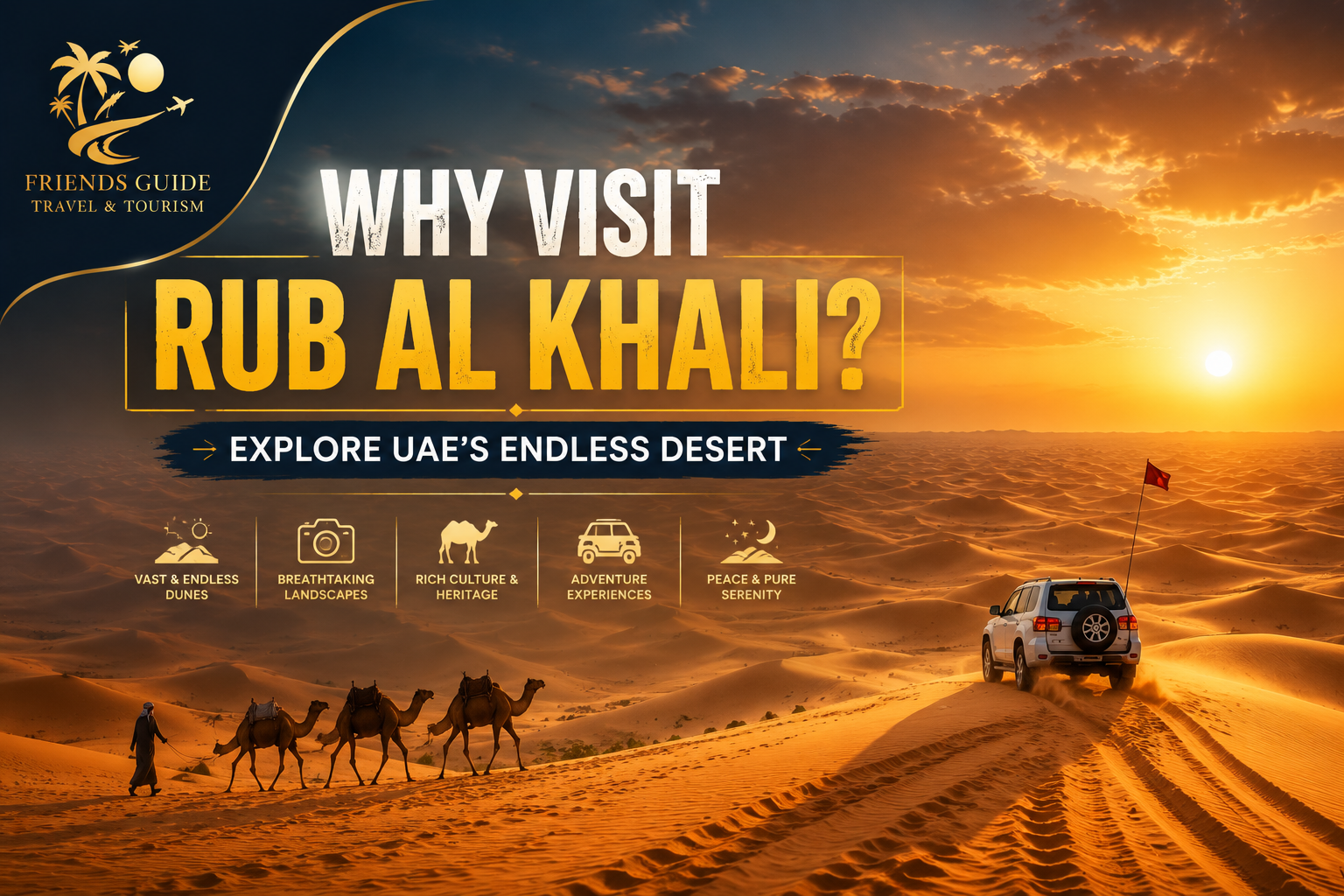
Important travel notice: Rub’ al Khali is a remote desert region rather than an ordinary roadside attraction. Visitors should remain on approved roads or travel with an experienced guide in a suitable vehicle. Do not enter deep dunes alone or treat a rental car as an off-road expedition vehicle.
The United Arab Emirates is famous for modern skylines, luxury resorts, impressive mosques and family attractions. However, beyond the cities lies one of Arabia’s most extraordinary natural landscapes: Rub’ al Khali, also known as the Empty Quarter.
Stretching across the southern Arabian Peninsula, Rub’ al Khali is recognised as the world’s largest continuous sand desert. Its enormous dune systems extend through parts of Saudi Arabia, Oman, Yemen and the UAE.
In the UAE, the most practical gateway to this landscape is the Liwa Oasis and Al Dhafra region of Abu Dhabi. Here, travellers can see towering dunes, date-palm settlements, changing desert colours and horizons that appear to continue without end.
A visit to Rub’ al Khali is very different from a short desert safari near Dubai. The journey is longer, the environment is more remote and the sense of scale is much greater. It is ideal for nature lovers, photographers, adventure enthusiasts and travellers who want to discover a less crowded side of the UAE.
This guide explains why you should visit Rub’ al Khali in the UAE, what to see, how to reach Liwa, when to travel, what to pack and why professional planning is essential.
What Is Rub’ al Khali?
Rub’ al Khali means “Empty Quarter” in Arabic. It is an immense desert basin covering approximately 650,000 square kilometres across the southern Arabian Peninsula.
Most of the desert lies within Saudi Arabia, with smaller sections extending into the United Arab Emirates, Oman and Yemen. It is not completely contained within Abu Dhabi or the UAE.
The landscape contains:
- Long chains of sand dunes.
- High dune faces and sharp ridges.
- Open desert valleys.
- Wind-created sand patterns.
- Areas of golden, orange and reddish sand.
- Remote salt flats and desert plains.
- Very limited permanent settlement in its deepest areas.
The name “Empty Quarter” describes the scale and sparse population of the region. It does not mean the desert is lifeless or unimportant.
The environment contains specially adapted plants and animals, while people have historically used knowledge of water, routes, camels and seasonal conditions to travel around its edges.
Rub’ al Khali at a Glance
| Feature | Details |
|---|---|
| English name | Empty Quarter |
| Arabic name | Rub’ al Khali |
| Approximate area | About 650,000 square kilometres |
| Countries | Saudi Arabia, UAE, Oman and Yemen |
| UAE gateway | Liwa Oasis and Al Dhafra, Abu Dhabi |
| Main landscape | Continuous sand dunes, valleys and desert plains |
| Best general season | November to April |
| Recommended approach | Guided tour, managed resort or professionally planned trip |
| Suitable duration | Full day or overnight |
Where Is Rub’ al Khali in the UAE?
The UAE section of Rub’ al Khali is associated mainly with the western and southern areas of the Emirate of Abu Dhabi.
Liwa Oasis lies along the northern edge of the great dune system in the Al Dhafra region. The oasis is not one single village. It is a chain of settlements, farms and palm-growing areas spread across a broad desert arc.
Paved roads connect travellers with Liwa communities, resorts and recognised attractions. However, the open dunes beyond the road network can become extremely remote.
Liwa Is Not Near Central Dubai
Liwa should not be confused with common Dubai safari locations such as Lahbab, Al Awir or the areas sometimes called Big Red.
A normal Dubai desert safari is designed as a convenient half-day or evening experience. A Liwa journey usually requires a dedicated full day because of the distance and larger region being explored.
Travellers can read the guide to the top desert regions in the UAE to understand how Liwa differs from more accessible desert areas.
Top Reasons to Visit Rub’ al Khali in the UAE
1. Experience the True Scale of the Arabian Desert
Many UAE visitors see dunes during a short safari close to Dubai. Those landscapes are beautiful, but Rub’ al Khali offers a completely different sense of scale.
Dune systems appear layer after layer across the horizon, with fewer buildings, roads and camps interrupting the view.
The landscape makes travellers understand why the region has fascinated desert communities, explorers, photographers and writers for generations.
2. Escape Crowded Tourist Areas
Dubai and central Abu Dhabi contain busy roads, famous landmarks and popular attractions. Liwa provides a quieter environment where the natural landscape becomes the main attraction.
Visitors may hear little more than wind, footsteps and the movement of sand during a carefully chosen stop.
3. See Enormous Natural Dunes
The Liwa region is known for very large dune formations. Their height, slope and changing shapes create dramatic scenery for sightseeing and photography.
Visitors should appreciate the dunes from approved areas rather than attempting unsupported climbing or driving.
4. Watch an Unforgettable Desert Sunset
Late-afternoon light changes the dunes from pale gold to orange, copper and deep red. Shadows become longer and reveal the natural ridges of the sand.
Sunset stops depend on the package, route and season. Confirm that sunset viewing is included when it is one of your main reasons for booking.
5. Experience the Desert at Sunrise
An overnight stay gives travellers the opportunity to see the first light appear across the dunes.
Morning conditions can be quiet and