
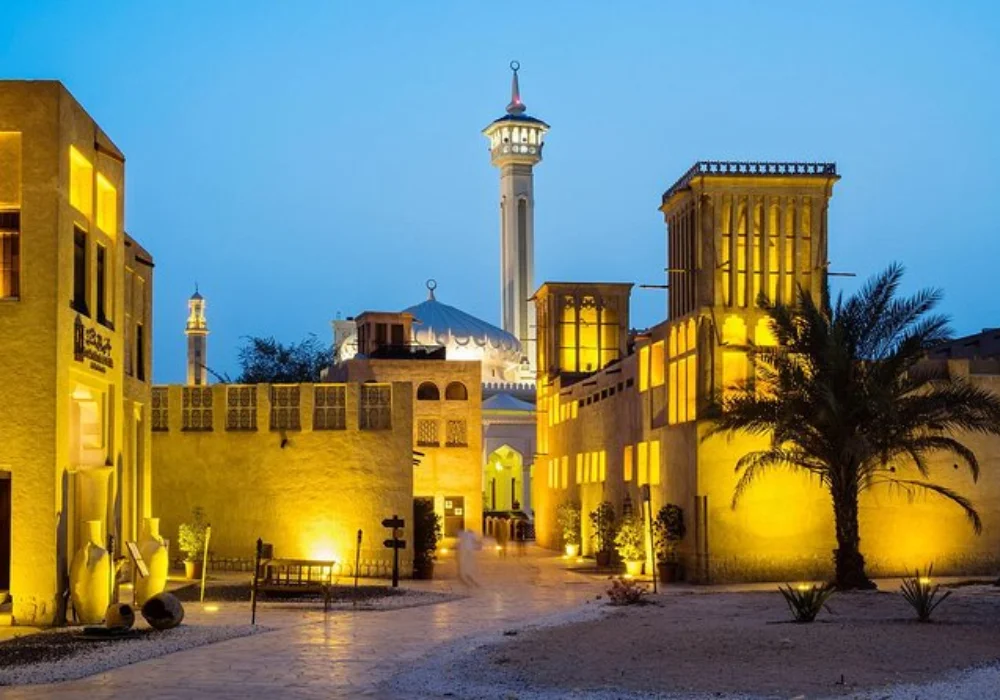
Al Fahidi Historical Neighbourhood is a place to slow down and look closely. Instead of a huge tower or a fast ride, you find narrow lanes, wind towers, shaded corners and buildings arranged around courtyards. Small details tell the story. A doorway, a patch of shade or the shape of a roof can become the most interesting part of the walk.
You can explore the public lanes at your own pace and choose a cultural stop if you want more explanation. This guide focuses on enjoying Al Fahidi itself. It helps you notice the buildings, choose a realistic visit length and understand which experiences need a separate booking. You do not have to turn every doorway into a stop on a long checklist.
What is Al Fahidi Historical Neighbourhood?
Al Fahidi is a restored heritage area in Bur Dubai, close to Dubai Creek. It preserves a different scale of city life from the modern skyline. Buildings sit close together, lanes bend between them and courtyards create quieter spaces inside. Today, cultural organisations, galleries, cafés and other visitor stops share parts of the neighbourhood.
It is a neighbourhood rather than one large museum hall. That matters when planning your visit. The public outdoor walk and the opening hours of individual buildings are different things. You may be able to enjoy the lanes while a particular gallery is closed, but you should not promise yourself access to every interior.
Al Fahidi, Al Seef and the souks are different places
Al Seef is a nearby Creek-side district with its own shopping and dining areas. The Deira Gold Souk and Spice Souk are across the water. They can fit into a wider Old Dubai outing, but they are not all inside Al Fahidi. Keep their locations separate in your map so you understand where the walking time goes.
If you want only a short heritage visit, stay in Al Fahidi and choose one indoor stop. If you have a half day, you can add a waterfront walk or a crossing later. Our Al Seef guide and Creek and souks itinerary help with those different parts of the day.
Is Al Fahidi free to visit?
Walking through the public lanes does not require a general attraction admission ticket. A meal, guided programme, exhibition or other venue can have its own price and booking rules. Ask about the specific experience rather than looking for one ticket that supposedly covers every building in the neighbourhood.
A simple budget can therefore be quite small: transport, water or a drink, and any chosen paid stop. A cultural meal or private tour can change that total. Decide which part is most valuable to you before buying extras. You can enjoy the architecture without booking an activity at every turn.
Choose a starting point you can recognise
Save the official Al Fahidi Historical Neighbourhood location and the address of any venue you have booked. A pin for a Metro station with a similar area name is not automatically your final entrance. Check the current station names, exits and pedestrian route in RTA's journey planner before leaving your hotel.
If you arrive by taxi, use a named public landmark near your first stop. Some heritage lanes are for pedestrians, so a driver may need to stop outside the closest edge rather than at the door. Agree on a practical drop-off and allow a little time to walk into the area.
A useful cultural landmark
The Sheikh Mohammed bin Rashid Al Maktoum Centre for Cultural Understanding, often shortened to SMCCU, gives its address as House 26, Al Fahidi Historical Neighbourhood, Al Musallah Street. This is useful if you have booked one of its programmes. Its office hours do not mean every programme runs continuously throughout those hours.
Save your actual confirmation with the meeting time and programme name. A cultural meal, a private heritage tour and a different public experience are separate bookings. Arrive with enough time to find the correct house rather than assuming any cultural venue in the neighbourhood can admit you to the same event.
A gentle self-guided walk through Al Fahidi
Begin with the outside of the buildings
For the first few minutes, put the attraction list away and look at the shape of the lanes. Notice where the sun reaches the ground and where walls create shade. Look up to see the wind towers. Then look down at the changes in surface and the small turns in the route.
This gives you a sense of the place before you enter anywhere. Walk at a pace that lets you stop safely without blocking a doorway. If another group arrives with a guide, let them pass or wait until there is room. A quiet corner is easier to enjoy when several groups are not competing for it.
Choose one or two lanes, then pause
You do not need to cover every lane to appreciate the area. Follow a small loop using your map and current public signs. Choose a comfortable turning point and check how the group feels. A short route with time to notice things can be more rewarding than a fast lap taken only to say you finished.
If you see a welcoming open venue, read its signs before entering. Check whether it is a gallery, café, office or private space. Not every open door is an invitation to wander through a building. Ask staff if you are unsure, and respect any area marked for staff or private use.
Add one stop with a clear purpose
Choose a stop that matches your interest. You might want a cultural conversation, an art visit or simply a drink in a pleasant setting. Check the opening hours, admission and likely duration directly. This keeps your walk focused and avoids spending the whole visit searching for a venue mentioned in an old guide.
Afterwards, decide whether to continue or finish. You can leave Al Fahidi feeling that you understood a few details rather than feeling disappointed that you missed ten names. If the heat or your group's energy changes, a shorter walk is a sensible adjustment, not a failed itinerary.
What to look for: wind towers
Wind towers are among the easiest features for a first-time visitor to notice. They rise above the buildings with openings near the top. They belong to a tradition of designing buildings around airflow and shade. A guide or cultural presenter can explain the local details more fully than a quick photograph can.
For a child, you can ask a simple question: how would you try to make a house more comfortable before modern air conditioning? Let them look for high openings, shaded walls and sheltered spaces. You do not need to give a long technical lesson. The buildings offer a clear starting point for curiosity.
Look at the tower and the building together
It is tempting to zoom in on a tower and ignore everything below it. Take a wider look as well. See how the tower sits above the roof, where the doorway is and how the lane runs beside the wall. Understanding the whole setting makes the detail more meaningful.
Do not climb onto a wall, roof or stairway to get a closer view unless it is clearly part of an authorised visitor route. Heritage buildings can have restricted areas. You can often make a useful photograph from the public lane by stepping back carefully and including part of the street.
What to look for: courtyards and doorways
A courtyard is an open space within or beside a group of rooms. In a heritage setting, it can make the inside of a building feel quite different from the lane outside. Some visitor venues use these spaces for meals, exhibitions or conversation. Access depends on the venue, not on the fact that you can see a doorway.
Notice how a small entrance can lead to a larger space. Look at door shapes, screens and the relationship between light and shade. Ask permission before photographing inside. If people are eating or attending a programme, give them the same privacy you would want during your own meal.
A simple observation game
Ask children to find three different door shapes or compare two patches of shade. They can draw a quick wind tower in a notebook while sitting somewhere suitable. Keep activities off busy paths and away from private doorways. A small task can hold their interest without turning the neighbourhood into a playground.
For adults, a useful question is what the building makes easy: gathering, keeping out direct sun, or moving between rooms. You do not need to pretend to be an architect. Looking for practical choices helps you move beyond taking the same photo at every corner.
Cultural meals: a booked conversation, not just a restaurant table
SMCCU offers cultural meals where visitors can try Emirati food and talk with a host about customs and daily life. These are scheduled programmes, not an all-day drop-in buffet. Check the meal type, date, duration, seating arrangement and dietary needs before booking. A cultural breakfast and a dinner can have different calendars.
The official meal page checked on 25 October 2026 lists different breakfasts, brunches, lunches, tea-time programmes and dinners. For example, its published breakfast and brunch references start at AED 130 per person. Use the official booking for your exact date rather than treating one starting amount as the price of every meal.
Preparing for the conversation
Think of one or two questions you would like to ask. They can be simple: how coffee is served, what a particular dish is called or how a family celebrates an occasion. Listen to the host's explanation and leave room for other guests. A respectful question is a good way to learn without needing special background knowledge.
Tell the organiser about dietary restrictions before the day. Ask whether the seating suits anyone who needs a chair rather than floor cushions. A programme described as traditional may have arrangements that need advance discussion. Confirm practical needs directly instead of assuming a general visitor welcome covers every situation.
Guided heritage experiences: read the actual product
A guide can explain details you might miss alone and answer questions as you walk. That can be valuable if history is your main interest. However, programmes differ in group size, language, route and included interiors. Ask for the exact experience, not simply any tour using the words Old Dubai.
SMCCU's currently published private Heritage Tour describes a programme of about one and a half hours and a minimum of 12 paid participants. That is a group product, not evidence that a solo visitor can join the same tour on demand. Ask about current public alternatives if you are travelling as a couple or small family.
Do not confuse office hours with tour departures
An organisation may be open to enquiries for much of the day while running only a few visitor sessions. Check a departure or reservation time in writing. Arriving during office hours without a booking can still mean missing the experience you wanted. This is especially important when your schedule leaves only one morning in the area.
Our city tour options can also include heritage areas, depending on the selected package. Ask whether the stop is a guided walk, a quick photo stop or free browsing time. Those are different uses of your day and should be compared honestly.
Galleries, museums and other interiors
Al Fahidi is associated with galleries, exhibitions and cultural venues, but individual openings and displays can change. Pick a venue from its current official information and confirm the date. Do not build the whole visit around an old online list that treats every named museum as permanently open.
The same care applies to nearby Al Fahidi Fort and Dubai Museum references. A location appearing on a map does not prove that its interior is open to visitors today. Check Dubai Culture's current information before promising an entry. An exterior look can be worthwhile, but it is different from a confirmed museum visit.
How long should you spend in Al Fahidi?
For a gentle outdoor introduction, allow roughly an hour and adjust to your pace. Add the full booked duration of any meal or tour rather than trying to squeeze it into that same hour. A drink stop, photographs and a slow walk can easily turn a short visit into a pleasant longer morning.
If you have a timed experience, plan backwards from its reporting time. Give yourself a transport buffer and time to find the house. Keep the outdoor loop after the session if arrival is uncertain. It is much less stressful to shorten an optional walk than to miss a programme you already paid for.
Weather, clothing and access needs
Many parts of this visit are outdoors. Shade from buildings helps in places, but it does not remove the effect of a hot day. Choose a comfortable time, carry water and wear shoes suited to walking. A small bag is easier to manage in narrow lanes than large luggage.
For mobility needs, check both the street route and the specific interior. Heritage buildings can have steps, uneven surfaces or entrances that need assistance. Ask a venue for practical details rather than a general yes-or-no answer about accessibility. If a seated break matters, identify a suitable open venue before starting.
Dress for the places you will actually enter
Comfortable, respectful clothing suits a public cultural area. A mosque visit included in a programme can have more specific requirements, which the organiser should explain. Do not assume a casual outdoor walk and a religious interior use identical rules. Check the programme instructions before leaving the hotel so you can carry any needed covering.
Take photographs thoughtfully. Ask before recording staff, residents or other visitors closely. Keep voices moderate around active programmes and private spaces. Simple courtesy helps the neighbourhood remain a place for learning and everyday work as well as sightseeing.
Where to go after the walk
If you still want a waterfront setting, Al Seef is a nearby option with a different feel. If markets are your main interest, plan the route to an abra station and the onward walk in Deira. Do not add both automatically. Your group may be happier finishing with one meal after a focused heritage visit.
For a separate history experience, explore our Al Shindagha Museum planning guide. For a completely different part of Dubai on another day, browse the attractions list. Matching each visit to your interests is more useful than filling every spare hour with another stop.
Three questions that make the walk more memorable
Try asking your group which space feels most comfortable, which building detail they would like explained and what looks different from the Dubai they expected. These questions work for adults and children. They encourage people to look at the same place from different points of view, rather than copying a list of famous stops.
If you join a cultural session, take those observations with you. A question about something you actually noticed is often easier to discuss than a broad request to explain an entire culture. You can leave with a few clear answers and a stronger memory of the neighbourhood, even after a fairly short visit.
10 frequently asked questions about Al Fahidi
1. What is Al Fahidi Historical Neighbourhood?
It is a restored heritage area in Bur Dubai near the Creek, known for narrow lanes, wind-tower buildings and cultural venues. It is a neighbourhood with several visitor stops rather than one museum covered by a single ticket.
2. Is the public walk free?
The public outdoor lanes do not require a general attraction admission ticket. Individual meals, tours, exhibitions and venues can have their own prices. Check the experience you want rather than assuming one payment covers the whole area.
3. Can I explore without a guide?
Yes, you can take a self-guided walk through public areas and choose an open venue if you wish. A booked guide or cultural programme can add explanation. Respect private entrances and follow current signs about visitor access.
4. How long should I allow?
Roughly an hour can work for a gentle outdoor introduction, depending on your pace. Add the complete duration of any meal or programme, plus time to find its meeting point. There is no need to walk every lane.
5. Is Al Fahidi the same as Al Seef?
No. They are nearby but different areas. Al Fahidi focuses on heritage lanes and buildings, while Al Seef offers a Creek-side shopping and dining setting. You can combine them if you allow the connecting walk and enough time.
6. What can children enjoy here?
Children can spot wind towers, compare doorways and look for patterns of light and shade. Keep the route short and plan a break. A simple observation game usually works better than expecting them to follow a long list of historical names.
7. Do cultural meals need booking?
SMCCU cultural meals are scheduled experiences and require a booking. Check the meal type, date, current price and dietary arrangements directly. Office opening hours do not mean that a meal programme is available at every hour.
8. Can a solo visitor book the private Heritage Tour?
The currently published SMCCU private Heritage Tour has a minimum of 12 paid participants. Ask the organiser about current public options or a suitable alternative. Do not assume that the private group product is a drop-in tour.
9. Is every museum or gallery open daily?
No single schedule covers all the interiors. Confirm your chosen venue from current official information before travelling. A map listing or an old guide is not proof of present opening, especially for a museum undergoing changes.
10. Is the area suitable for a wheelchair?
Check the exact route and venue entrances, as heritage lanes and buildings can include uneven surfaces or steps. Explain your practical needs to the organiser. A confirmed access plan is more useful than a broad description of the area as walkable.
To arrange a heritage stop within a wider sightseeing day, contact Friends Guide Travels with your date, hotel area and preferred pace. Tell us whether you want a guided explanation, a cultural programme or a simple independent walk.
Sources checked 25 October 2026: Visit Dubai: Al Fahidi, SMCCU cultural meals and SMCCU private Heritage Tour. Individual programmes, prices and venue access should be confirmed for your date.