
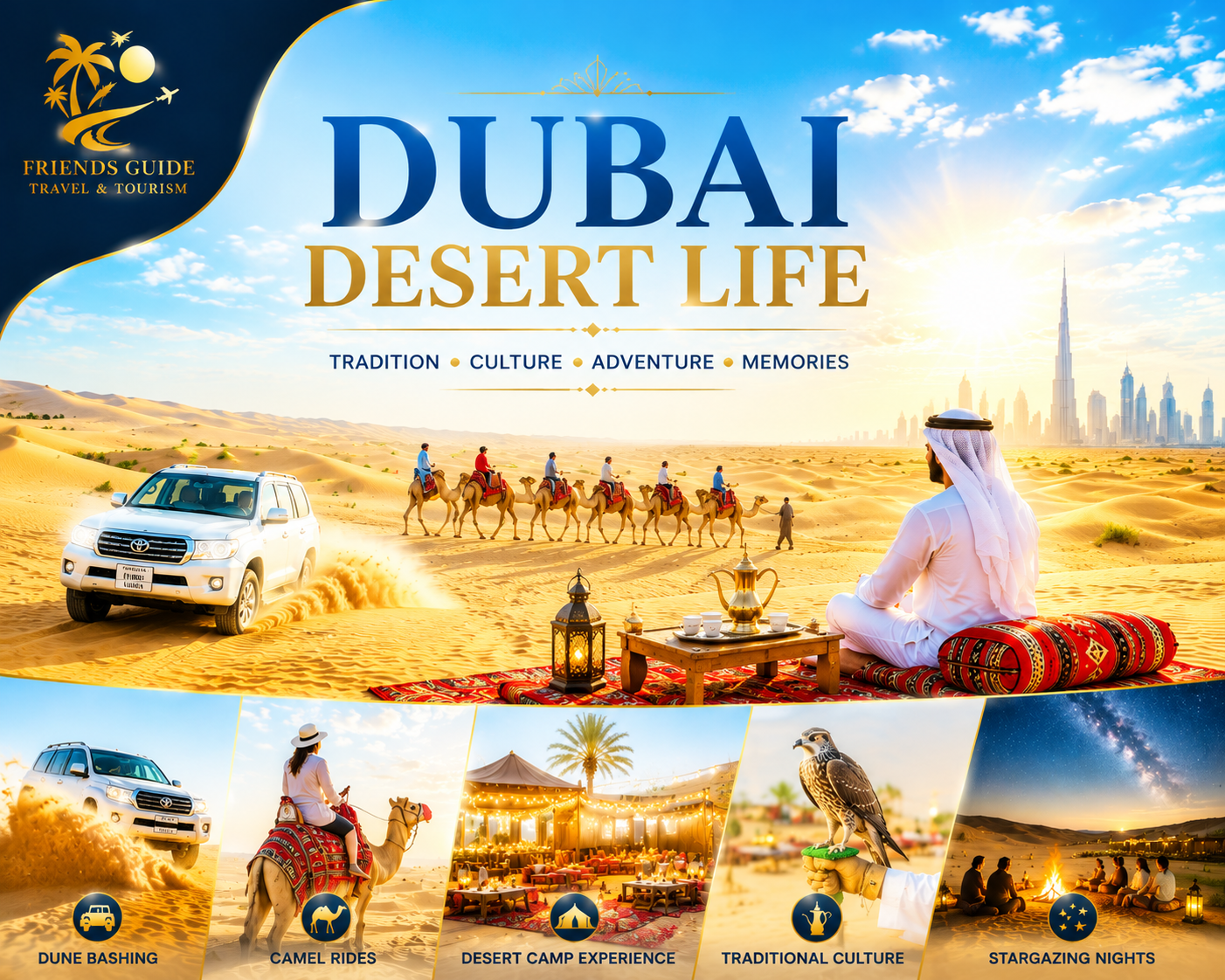
Dubai is internationally recognised for its skyscrapers, shopping centres, luxury hotels and modern attractions. However, beyond the busy city lies a completely different world filled with rolling dunes, native wildlife, camel traditions, desert camps and centuries of cultural history.
Dubai desert life is more than dune bashing and tourist photographs. The desert shaped how earlier communities travelled, found food, protected themselves from the climate and welcomed guests. Camels, falcons, wells, seasonal movement and strong family connections were all important parts of life in the Arabian environment.
Today, visitors can experience this heritage through camel treks, wildlife tours, falconry demonstrations, Bedouin-inspired camps, desert safaris, camping and cultural storytelling. Modern desert tourism also includes quad bikes, dune buggies, premium dinners and comfortable overnight accommodation.
Understanding the desert’s culture, plants and animals makes a Dubai safari more meaningful. Instead of seeing the landscape as empty sand, travellers begin to recognise it as a sensitive natural ecosystem and an important part of Emirati identity.
This complete guide explains traditional and modern desert life in Dubai, the best experiences to book, what wildlife you may see, how to dress and how to explore the dunes responsibly.
Important Dubai Desert Notice
Dubai’s desert includes open tourism areas, private land and protected conservation reserves. Visitors should not drive into unknown dunes or restricted habitats without permission, a suitable vehicle and proper off-road experience.
Wildlife sightings, sunsets and entertainment programmes cannot be guaranteed. Weather, local regulations, religious occasions and operational conditions may affect individual safari activities.
What Does Dubai Desert Life Mean?
Dubai desert life describes the relationship between people, animals and the natural environment beyond the city. It includes both the traditional lifestyle that developed over generations and the modern activities found in the desert today.
Traditional desert life focused on survival, seasonal travel, livestock, family cooperation and the careful use of limited natural resources. Modern desert life includes conservation, camel racing, farms, tourism camps, adventure activities and environmental research.
Dubai Desert Life Includes:
- Bedouin heritage and storytelling
- Camel transport and camel racing
- Falconry traditions
- Desert wildlife and plants
- Family and community hospitality
- Dune bashing and off-road driving
- Camping and stargazing
- Wildlife conservation
- Modern safari camps and tourism
Travellers who understand these different elements can enjoy a richer desert experience than visitors who focus only on motorised adventure.
Traditional Bedouin Life in the Dubai Desert
The word Bedouin is associated with communities that traditionally lived in or travelled through desert environments. Some groups moved seasonally according to water, grazing conditions, trade and weather, while others maintained connections with coastal settlements and oasis communities.
Desert life required detailed knowledge of the landscape. People understood where water could be found, how the wind changed the dunes and which routes were suitable for camels and livestock.
Important Parts of Traditional Desert Life
- Travelling between water and grazing areas
- Keeping camels, goats and other livestock
- Using stars and landmarks for navigation
- Trading with coastal and inland communities
- Building temporary and practical shelters
- Sharing food, water and protection with guests
- Passing knowledge through stories and poetry
The environment encouraged patience, resilience and cooperation. A mistake involving water, navigation or weather could have serious consequences, so knowledge was shared carefully between generations.
How Did People Find Water and Food in the Desert?
Water was the most valuable resource in traditional desert life. Communities depended on wells, seasonal water sources, oases and knowledge of the land.
Travel routes were planned according to the distance between reliable water points. Camels could manage long desert journeys, but people still needed careful preparation and secure supplies.
Traditional Food Sources
- Dates
- Camel and goat milk
- Rice and grains received through trade
- Dried or preserved foods
- Meat during selected occasions
- Fish and seafood obtained through coastal connections
Meals were often simple but nourishing. Tea, coffee and dates also became important parts of welcoming visitors and sharing hospitality.
The Importance of Camels in Dubai Desert Life
Camels played a central role in life across the Arabian Peninsula. Their ability to move across soft sand and manage difficult conditions made them valuable for transport, trade and everyday survival.
The camels traditionally found in the UAE are generally dromedaries with one hump. Their hump stores fat rather than water and provides an important energy reserve.
How Camels Supported Desert Communities
- Transporting people
- Carrying trading goods and supplies
- Providing milk
- Supporting long-distance desert travel
- Connecting settlements and markets
- Participating in racing and cultural celebrations
Camels continue to hold cultural importance in the UAE. Visitors can see camel farms, racing traditions and guided trekking experiences throughout Dubai’s desert areas.
Travellers who want more than a short camp ride can reserve the Dubai Extended Camel Ride and Red Dunes Safari.
Falconry and Dubai’s Desert Heritage
Falconry is another important part of Emirati and Arabian heritage. Falcons were historically trained to assist with hunting in environments where food was limited.
The partnership between a falcon and its handler required patience, trust and detailed knowledge of the bird’s behaviour.
Modern Falconry Experiences May Include:
- A professional falconry demonstration
- Information about different falcon species
- An explanation of traditional hunting methods
- A supervised photography opportunity
- Stories about the cultural importance of falcons
Falcon photography is not included in every desert safari. It should appear clearly in the selected package or booking confirmation.
Food, Coffee and Arabian Hospitality
Hospitality has always been essential in the desert. Travellers depended on one another, and welcoming a guest with food, water and shelter was considered an important responsibility.
Modern safari camps often introduce visitors to this tradition through welcome refreshments, Arabic coffee, dates and shared meals.
Common Camp Experiences
- Arabic coffee
- Dates
- Tea
- Traditional-style seating
- Buffet dinner
- Shared cultural activities
Modern tourist buffets are generally much larger and more international than the simple meals associated with earlier desert life. They should be understood as a contemporary hospitality experience rather than an exact recreation of historic daily food.
Traditional Desert Shelter and Clothing
Traditional shelter needed to be practical, portable and suitable for strong sun, wind and changing temperatures.
Tents provided shade during the day and protection during cooler nights. Natural materials such as animal hair and woven textiles were historically used in tent construction.
Why Traditional Clothing Was Practical
- Loose fabric supported air movement.
- Long clothing protected skin from direct sunlight.
- Head coverings provided protection from sun and sand.
- Layers helped people manage changing temperatures.
Today’s desert visitors do not need to wear traditional clothing. Comfortable, breathable clothes and secure footwear are generally the most practical choices.
Wildlife in Dubai’s Desert
Dubai’s desert may appear quiet, but it supports many animals adapted to heat, limited water and difficult terrain.
Some animals are most active during the early morning, evening or night, which helps them avoid the strongest daytime heat.
Animals Associated with Dubai’s Desert Environment
- Arabian oryx
- Gazelles
- Desert foxes
- Hares and small rodents
- Reptiles and lizards
- Snakes
- Scorpions and insects
- Falcons and other desert birds
Wildlife sightings depend on location, season, time of day and natural behaviour. Visitors should never chase, touch or feed wild animals.
How to Observe Desert Wildlife Responsibly
- Remain quiet and keep a respectful distance.
- Use binoculars or a zoom lens.
- Do not leave food behind.
- Follow reserve and guide instructions.
- Avoid flash photography close to animals.
- Do not leave approved tracks.
Plants and the Dubai Desert Ecosystem
Desert plants are specially adapted to survive limited rainfall, strong sunlight and sandy soil. Some have deep root systems, while others grow quickly after rain and remain inactive during dry periods.
Vegetation provides shelter and food for insects, birds and mammals. Even a small desert shrub can play an important role within the ecosystem.
Why Desert Plants Must Be Protected
- They reduce movement of loose sand.
- They provide food for wildlife.
- They create shade and shelter.
- They support insects and small animals.
- They may take a long time to recover after damage.
Visitors should avoid driving across vegetation, removing plants or setting up camp directly on living shrubs.
Dubai’s Desert Conservation Areas
Conservation is an important part of modern Dubai desert life. Protected areas help preserve natural landscapes, native plants and wildlife while supporting research and carefully managed tourism.
Dubai Desert Conservation Reserve
The Dubai Desert Conservation Reserve protects a large area of inland desert and supports the conservation of indigenous plants and animals.
Access is managed, and visitors normally experience the reserve through approved operators, guided tours or designated visitor facilities rather than unrestricted off-road driving.
Al Marmoom Desert Conservation Reserve
Al Marmoom is known for open desert landscapes, wildlife, lakes, camel racing, cycling and Bedouin-inspired cultural experiences.
Visitors can explore selected parts of Al Marmoom through organised experiences involving camel caravans, falconry, Emirati food, heritage storytelling and wildlife observation.
Why Conservation Matters
- Protecting native wildlife
- Preserving desert plants
- Supporting environmental research
- Reducing damage from uncontrolled driving
- Teaching visitors about the desert ecosystem
- Protecting natural areas for future generations
Modern Life in Dubai’s Desert
Dubai’s desert is no longer used only for traditional transport and livestock. It now supports conservation projects, farms, camel racing, tourism camps, resorts, cycling routes, research and adventure activities.
Modern Desert Activities Include:
- Camel racing
- Wildlife conservation
- Environmental research
- Luxury desert resorts
- Glamping and overnight camps
- Desert safaris
- Dune buggies and quad bikes
- Photography and film production
- Heritage festivals and cultural programmes
Modern tourism can provide employment and support cultural education, but it must be carefully managed to avoid damage to wildlife and natural habitats.
Experience Dubai Desert Life on an Evening Safari
An evening desert safari is one of the easiest ways for visitors to experience Dubai’s dunes, culture and outdoor activities in one organised tour.
A standard Evening Desert Safari Dubai may include:
- Pickup from a confirmed location
- Air-conditioned desert transportation
- 4×4 dune bashing
- Sunset photography
- Sandboarding
- Short camel ride
- Bedouin-inspired camp access
- BBQ buffet dinner
- Scheduled live entertainment
- Return transportation
Exact inclusions depend on the package selected. Quad biking, premium seating, dune buggies, falcon photography and extended camel rides may cost extra.
Standard or Premium Safari?
Standard safaris are suitable for budget-conscious travellers and first-time visitors. Premium packages normally focus on improved seating, service and camp comfort.
Travellers seeking upgraded hospitality can compare the Premium Evening Desert Safari Dubai.
Camel Riding and Desert Treks
A short camel ride is included in many safari programmes. It normally takes place near the camp and is designed as a simple introduction and photography opportunity.
A dedicated camel trek provides more riding time and a stronger connection with traditional desert travel.
Short Ride vs Extended Camel Trek
- Short camp ride: Suitable for first-time guests and photographs
- Extended trek: Better for travellers whose main interest is camel riding
- Sunrise trek: Cooler conditions and peaceful surroundings
- Sunset trek: Golden light and evening desert scenery
Follow the handler’s instructions when the camel stands or sits. Riders with back, hip, knee or mobility concerns should discuss suitability before booking.
Dune Bashing Across Dubai’s Sand Dunes
Dune bashing is a professionally driven off-road journey through the desert. Guests remain inside a prepared 4×4 vehicle while an experienced driver controls the climbs, turns and descents.
Important Dune-Bashing Rules
- Keep your seat belt fastened.
- Follow the driver’s safety instructions.
- Do not stand or move around during the drive.
- Inform the team about medical concerns.
- Keep loose belongings secured.
- Do not participate after consuming alcohol.
Pregnant travellers and guests with serious back, neck, heart or mobility conditions should avoid dune bashing. A direct camp transfer may be available depending on the operator.
Quad Bikes and Dune Buggies
Motorised self-drive activities have become a major part of modern Dubai desert tourism.
Quad Bikes
Quad bikes use handlebar controls and an open riding position. They may operate inside a controlled area or on a guided route.
Dune Buggies
Dune buggies normally use a steering wheel, safety frame and harness system. One-, two- and four-seat vehicles may be available.
Adventure travellers can book a dedicated Dubai Desert Buggy Driving Experience.
Before Booking a Motorised Activity
- Confirm the vehicle model.
- Check the actual driving duration.
- Review minimum age requirements.
- Ask whether a licence is required.
- Confirm helmet and safety equipment.
- Check whether the route is fenced or open.
- Review the damage and cancellation policy.
Dubai Desert Camps and Cultural Activities
After the outdoor safari activities, many tours continue to a Bedouin-inspired desert camp.
These tourism camps use traditional visual elements while providing modern services such as washrooms, dining areas, lighting and organised stages.
Camp Activities May Include:
- Arabic coffee and dates
- Henna painting
- Traditional clothing photography
- Short camel rides
- Souvenir stalls
- Shisha in a designated area
- Buffet dining
- Live performances
Not every activity is guaranteed daily. Henna, shisha, photography and entertainment can depend on the camp, package and local operating conditions.
Overnight Desert Camping and Stargazing
Staying overnight allows visitors to experience the desert after the main evening safari groups have left.
The camp becomes quieter, artificial lights are reduced and guests can observe the night sky before waking for sunrise.
An Overnight Desert Safari Dubai may include:
- Evening safari activities
- BBQ dinner
- Sleeping equipment
- Overnight camp stay
- Stargazing
- Desert sunrise
- Breakfast according to the package
- Return transportation
Before Booking an Overnight Safari
- Confirm whether the tent is shared or private.
- Ask whether a mattress and blanket are provided.
- Check washroom availability.
- Ask whether breakfast is included.
- Carry warm clothing during winter.
- Confirm the morning return time.
Desert Dinner and Evening Entertainment
Dinner is an important part of the modern safari experience. A typical buffet may include salads, rice, breads, grilled items, vegetarian dishes, non-vegetarian food and desserts.
Menus vary between camps and packages. Visitors with allergies, Jain-food requirements, vegan diets or strict medical needs should request written confirmation before travelling.
Common Entertainment May Include:
- Tanoura performance
- Fire show
- Belly-dance performance where permitted
- Music or other cultural presentations
Entertainment may be modified during Ramadan, religious occasions, official mourning periods or government restrictions.
Best Dubai Desert Experiences for Different Travellers
First-Time Visitors
Choose a standard evening safari with transportation, dune bashing, camel riding, dinner and entertainment.
Families
Select a private vehicle or premium package and confirm child suitability for dune bashing and motorised activities.
Couples
A sunset safari, private 4×4 or overnight camp can provide greater privacy and memorable photography.
Solo Travellers
A shared safari offers organised transportation and an opportunity to join other visitors without arranging a private vehicle.
Adventure Travellers
Choose Lahbab red dunes, a longer quad-bike session or a dedicated buggy-driving package.
Culture and Nature Lovers
Select Al Marmoom or an approved Dubai Desert Conservation Reserve experience focusing on wildlife, falconry, camels and heritage.
Guests Seeking Comfort
Choose a premium safari, glamping package or luxury conservation-reserve dinner.
What Is the Best Time to Explore Dubai’s Desert?
October to April
The cooler months are generally the most comfortable for dune activities, camel rides, camping and outdoor dining.
Morning
Morning safaris provide cooler temperatures, bright photography and a shorter activity schedule.
Sunset and Evening
Evening safaris are the most popular because they combine adventure, sunset, dinner and entertainment.
Summer
Desert tours continue during summer, but itineraries may be adjusted to reduce exposure to the hottest part of the day.
Visitors should drink water regularly, use sun protection and inform the guide immediately when feeling dizzy or unwell.
What Should You Wear in the Dubai Desert?
Recommended Clothing
- Lightweight, breathable clothing
- Comfortable trousers or sportswear
- Secure trainers or closed shoes
- Sunglasses
- Sun hat or cap
- Light jacket during winter evenings
- Warmer layer for overnight camping
Avoid Wearing:
- High heels
- Loose flip-flops during activities
- Long unsecured scarves
- Heavy jewellery
- Delicate clothes that may be damaged by sand
- Large unsecured handbags
What Should You Carry for a Desert Safari?
- Booking confirmation
- Accepted identification when required
- Sunscreen
- Sunglasses
- Fully charged mobile phone
- Power bank
- Personal medication
- Light jacket
- Small secure bag
- Camera with protective cover
Avoid carrying large luggage into the desert. Sand can enter phones, cameras and bags, so protect sensitive equipment when it is not being used.
Health and Safety Guidance
Inform the Booking Team About:
- Pregnancy
- Back or neck conditions
- Heart problems
- Recent surgery or injury
- Serious mobility limitations
- Severe motion sickness
- Food allergies
- Medication that may affect concentration
General Desert Safety Tips
- Use a licensed safari company.
- Follow the driver and guide.
- Keep seat belts fastened.
- Do not enter remote dunes alone.
- Do not walk across active driving tracks.
- Supervise children around animals and vehicles.
- Check the weather before travelling.
- Avoid low-lying areas during rain.
- Do not participate under the influence of alcohol.
How to Experience Dubai Desert Life Responsibly
The desert is a sensitive natural environment. Responsible tourism helps protect wildlife, plants and cultural heritage.
Responsible Visitor Rules
- Do not leave plastic, food or charcoal behind.
- Do not feed wildlife.
- Do not remove plants, rocks or natural objects.
- Do not drive across vegetation.
- Remain inside permitted activity areas.
- Keep noise low near wildlife.
- Use raised BBQ equipment where fires are permitted.
- Do not bring personal fireworks.
- Follow conservation-reserve rules.
A good desert experience should leave the environment in the same or better condition than it was found.
Suggested One-Day Dubai Desert Life Itinerary
Morning
- Relax at the hotel or explore a city attraction.
- Wear comfortable desert clothing.
- Charge your phone and camera.
- Prepare sun protection and a jacket.
Afternoon Pickup
- Meet the confirmed safari driver.
- Travel from the city towards the desert.
- Complete any optional quad-bike or buggy activity.
Late Afternoon
- Experience 4×4 dune bashing.
- Try sandboarding.
- Stop for desert photography.
- Watch the sunset.
Evening Camp
- Enjoy a short camel ride.
- Try cultural camp activities.
- Have a BBQ buffet dinner.
- Watch the scheduled entertainment.
Night
- Return to Dubai after the camp programme.
- Alternatively, remain for an overnight desert safari.
Experience Dubai Desert Life with Friends Guide Travel & Tourism
Friends Guide Travel & Tourism LLC is a Dubai-based travel company offering evening safaris, premium camps, overnight stays, camel rides, quad bikes, dune buggies and private desert experiences.
Why Book with Friends Guide Travels?
- Licensed UAE travel and tourism company
- Professional local booking assistance
- Experienced desert safari drivers
- Shared and private transportation options
- Standard, VIP and premium safari packages
- Quad-bike and dune-buggy assistance
- Family, couple and group arrangements
- Clear explanation of inclusions
- Support before and after booking
Contact our team with your travel date, number of guests, pickup location and preferred desert experience.
Phone:
+971 52 757 3085
Email:
info@friendsguidetravels.com
Address:
Shop No. 6, Friends Residency, Al Warsan 4, Phase 2, Dubai, UAE
Frequently Asked Questions About Dubai Desert Life
What was traditional life like in the Dubai desert?
Traditional desert life depended on water sources, livestock, camel transport, seasonal movement, trade, family cooperation and knowledge of the landscape.
Who are the Bedouins?
Bedouins are communities historically associated with desert and semi-desert regions. Some travelled seasonally according to water, grazing and trade conditions.
Why were camels important in Dubai?
Camels transported people and goods, provided milk and helped connect distant desert, coastal and oasis communities.
Does a camel’s hump store water?
No. A camel’s hump stores fat, which can be used as an energy reserve when food is limited.
What animals live in Dubai’s desert?
The desert supports Arabian oryx, gazelles, foxes, hares, reptiles, rodents, insects and several bird species.
Are wildlife sightings guaranteed during a safari?
No. Wildlife sightings depend on the location, season, time of day and natural animal behaviour.
What is the Dubai Desert Conservation Reserve?
It is a protected desert reserve created to preserve Dubai’s natural landscape, indigenous plants and native animals.
What is Al Marmoom known for?
Al Marmoom is known for wildlife, lakes, camel racing, cycling, Bedouin-inspired experiences, falconry and heritage activities.
What happens during a Dubai desert safari?
Depending on the package, a safari may include pickup, dune bashing, sandboarding, sunset photography, camel riding, camp activities, dinner and entertainment.
Is camel riding included in a desert safari?
A short camel ride is included in many packages. A longer trek requires a dedicated extended camel-ride option.
Is quad biking included in every safari?
No. Quad biking is generally optional unless it is clearly included in the selected package.
What is the difference between dune bashing and dune buggy driving?
During dune bashing, a professional driver controls a 4×4 vehicle. During buggy driving, an eligible guest operates a specialist off-road vehicle.
Is a desert safari suitable for children?
Many families join desert safaris, but parents should confirm whether dune bashing and optional motorised activities are suitable for their children.
Can pregnant women join a desert safari?
Pregnant travellers are generally advised to avoid dune bashing and motorised off-road activities. A direct camp transfer may be available.
What is the best time for a Dubai desert safari?
October to April generally provides the most comfortable weather. Evening safaris are popular for sunset, dinner and entertainment.
Does the Dubai desert get cold at night?
The desert can feel cool after sunset, especially during winter. Carry a jacket and warmer clothing for overnight stays.
What should I wear for a desert safari?
Wear breathable clothing, comfortable trousers and secure shoes. Avoid high heels, heavy jewellery and loose scarves.
Can tourists camp overnight in the Dubai desert?
Yes. An organised overnight safari is the easiest option for visitors without local camping or off-road experience.
How can visitors protect the desert environment?
Do not litter, feed wildlife, damage plants, remove natural objects or drive outside approved routes.
How can I book a Dubai desert experience?
Contact Friends Guide Travel & Tourism LLC with your date, group size, pickup point and preferred activities. Confirm all inclusions before payment.
Final Thoughts
Dubai desert life represents an important connection between the emirate’s heritage, natural environment and modern tourism.
Camels, falconry, hospitality and knowledge of the land supported earlier desert communities. Today, conservation reserves protect native wildlife while organised safaris allow visitors to experience dunes, cultural activities and outdoor adventure.
Choose a standard evening safari for a complete introduction, an extended camel trek for a traditional journey, a dune buggy for adventure or an overnight safari for stargazing and sunrise.
Follow the guide’s instructions, respect wildlife and leave no waste behind. Responsible travel helps protect Dubai’s desert for future residents and visitors.
Book your Evening Desert Safari Dubai, Premium Evening Desert Safari or Overnight Desert Safari with Friends Guide Travel & Tourism LLC and discover the culture, wildlife and natural beauty of Dubai’s Arabian desert.